Kayseri and Cappadocia at the foot of Mount Erciyes
Seljuk stonework in the shadow of an extinct volcano, fairy chimneys, underground cities and one of Turkey's proudest kitchens. A guide to Kayseri as a destination in its own right, not just the gateway to Cappadocia.
November 13, 2026 · 3 min read
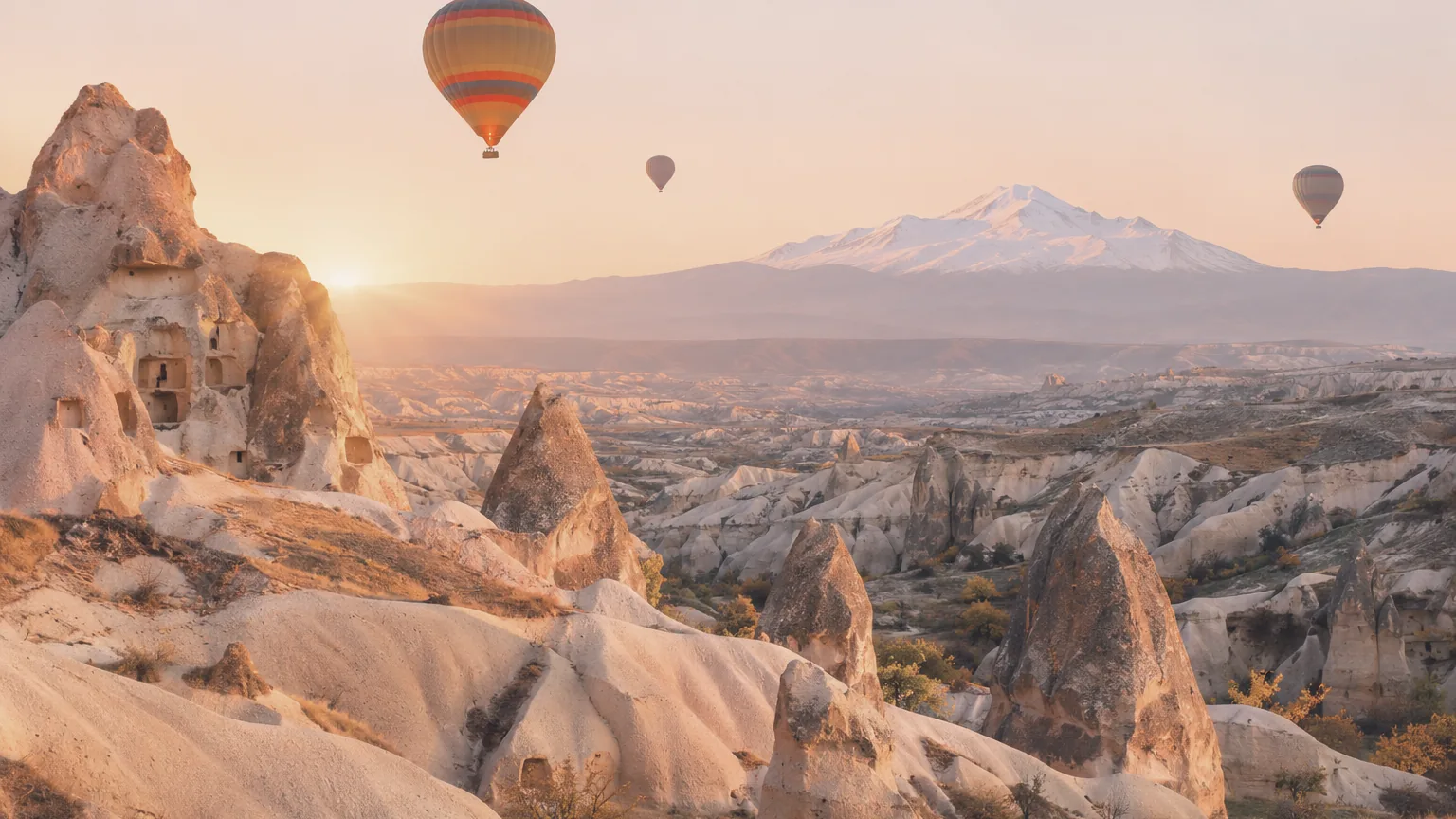
Whichever way you arrive in Kayseri, Mount Erciyes greets you first. At 3,917 metres, this extinct volcano is the highest peak in Central Anatolia — a white summit in winter, a calm giant visible from every corner of the city in summer. Much of the story of the fairy-tale landscape we call Cappadocia begins with it.
This guide looks at Kayseri not only as the airport on the way to Cappadocia, but as a city with its own stone, its own table and its own mountain.
How the fairy chimneys were born
Millions of years ago, ash and lava from Erciyes, Hasandağı and Göllüdağ covered the region in a thick layer of tuff. Wind, rain and rivers slowly carved this soft rock, while columns protected by hard basalt caps were left standing. That is how the fairy chimneys came to be.
People learned early on to carve the soft rock too: rock-cut churches, dovecotes, homes and entire cities reaching deep underground. Göreme National Park and the Rock Sites of Cappadocia were inscribed on the UNESCO World Heritage List in 1985.
What to see in Cappadocia
- Göreme and its valleys: the heart of the region, with rock-cut churches and walking trails.
- Hot air balloons: when the weather allows, the sky fills with balloons at sunrise; flights depend entirely on conditions.
- Underground cities: Derinkuyu and Kaymaklı descend level by level through narrow passages and ventilation shafts.
- Soğanlı Valley: within Kayseri province, a quieter Cappadocia of rock churches and village life, away from the crowds.
The city itself: stones left by the Seljuks
Kayseri was one of the most important cities of the Anatolian Seljuks, and that heritage can still be explored on foot in the centre. The Hunat Hatun Complex — mosque, madrasa and bathhouse — stands right in the middle of town. The Gevher Nesibe Hospital, founded in the early 13th century as a hospital and medical school, is now a museum of medical history.
Kayseri Castle, with its walls of dark basalt, and the covered bazaar beside it are a good place to feel the city's trading spirit. It is also worth remembering that Mimar Sinan, the great Ottoman architect, was born in Ağırnas, a village in Kayseri; his house there can be visited today.
Erciyes: a mountain for all seasons
Erciyes Ski Resort is one of the most extensive ski areas in Turkey, and its closeness to the city means you can spend the morning in town and the afternoon on the slopes. When the snow melts, the mountain belongs to hikers and cyclists.
A note for birdwatchers: Sultan Sazlığı, south of Kayseri, is an internationally important wetland and a stopover for migrating birds.
At the table: mantı, pastırma and yağlama
You can't leave Kayseri without getting to know its table. Kayseri mantı — dumplings so tiny that, as the saying goes, forty should fit on one spoon — is the city's pride. Pastırma and sucuk are crafts passed down for generations, making clever use of the dry, cold climate.
Less known but a local classic, yağlama is made of thin layers of flatbread with a spiced minced-meat filling. On the sweet side, Kayseri's patisseries and bakeries are fixtures of the city's daily rhythm.
Good to know
- Getting there: travellers flying to Cappadocia usually land at Kayseri or Nevşehir Kapadokya airport.
- Seasons: Central Anatolia has hot, dry summers and cold, snowy winters; spring and autumn are the most comfortable for walking.
- If you're planning a balloon flight, keep a spare morning in your schedule in case of weather cancellations.